Report the past, then model forward
Most training tools are rear-view mirrors: they total up what you did and chart it. Adaptive Training does that too — accurately — and then takes the next step, modeling where your fitness and form are heading so today's session is a decision, not a guess.
The reporting is solid and standard. The forward-looking models are clearly marked as estimates and are still being validated against what's already out there.
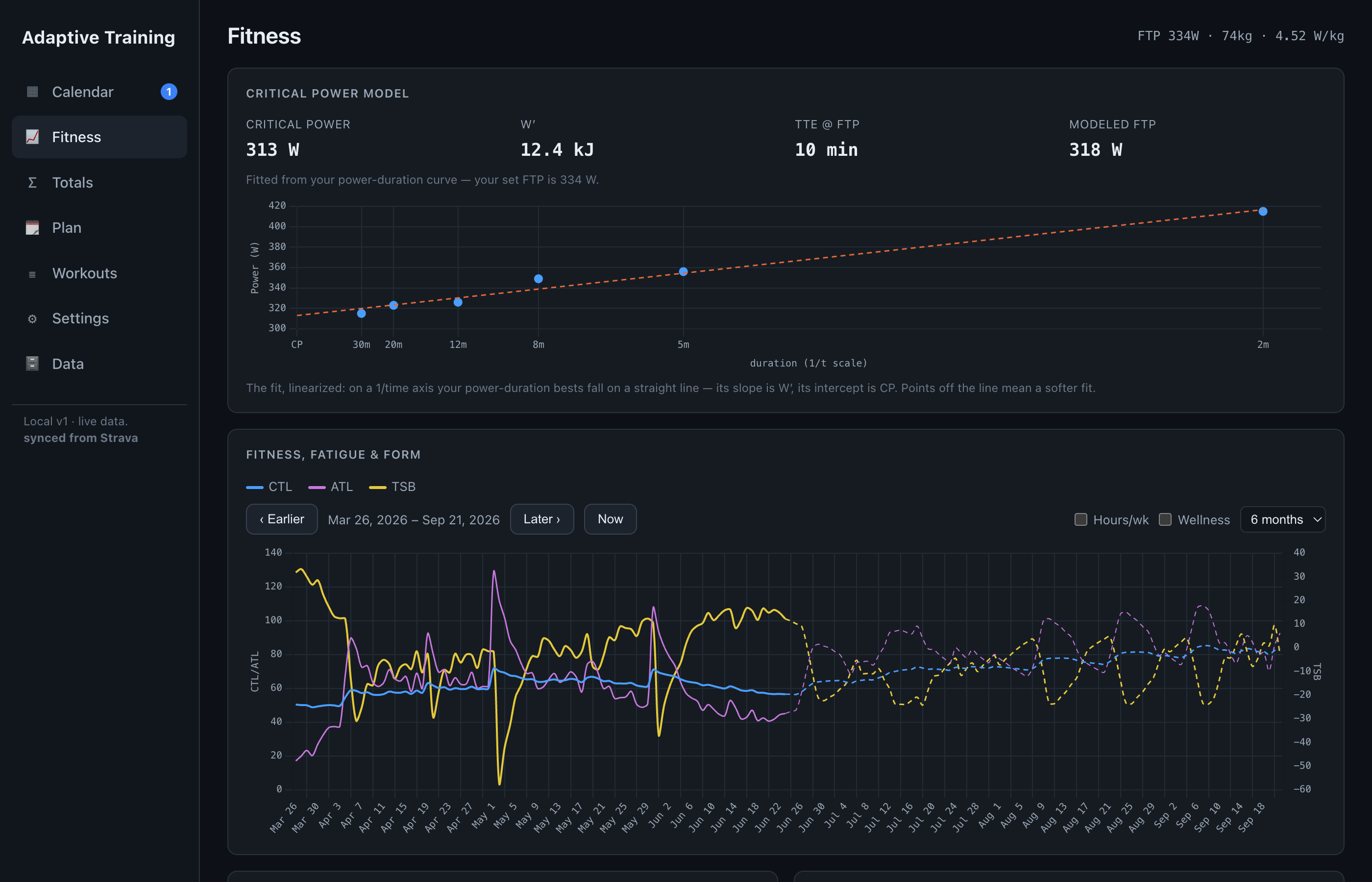
01 Fitness, fatigue & form
Every ride carries a training load. Adaptive Training rolls those loads into three exponentially-weighted averages: a slow one (fitness), a fast one (fatigue), and their difference (form). Build fitness without burying form and you arrive at an event both fit and fresh.
This is a Banister-style impulse-response model — the same shape GoldenCheetah and intervals.icu use, computed from your own rides.
02 The power-duration curve
For every duration from one second to hours, Adaptive Training finds your best-ever power and plots the curve. It's the most informative single picture of a cyclist: sprinters tower on the left, time-triallists hold up the right.
03 Critical Power & W′
Fit a curve to those bests and two numbers fall out: Critical Power (CP) — the highest intensity you can hold more or less indefinitely — and W′ ("W-prime"), the fixed pool of energy you have above CP. Think of W′ as an anaerobic battery: a set number of matches to burn before you blow up.
04 W′bal — the matchstick burn
Ride above CP and you spend W′; drop below and it recharges. Adaptive Training traces this W′ balance second-by-second beneath your power curve, so you can see exactly when a hard effort empties the battery — and whether you had enough left for the finish.
05 Durability
Fresh numbers flatter everyone. The races that matter are decided deep into a long ride, so Adaptive Training measures how much of your power you keep after 1,500, 2,500, and 3,500 kJ of work — your durability, the fade most tools never show you.
06 Defensible estimates
Not every activity has a power meter. Rather than invent a number, Adaptive Training falls back through a clear hierarchy — perceived effort, then heart rate, then a sane ceiling — so a hike or a kids' MTB lap never lands a wildly inflated training load.
07 Planning to an event
Pick a goal event and Adaptive Training estimates its demands — the durations and intensities it will ask of you — then compares them against your current curve to surface the gaps still standing between you and the start line. That's what shapes the sessions it suggests.
08 Fuelling to the work
Carbohydrate need follows energy expenditure, so each day's target is driven by the planned session's kilojoules (average power × duration) with the carbohydrate share of that energy rising as intensity does. A rolling window pre-loads the day before hard work and refuels the day after; easy days fall to a maintenance baseline — the fuel for the work required approach. Total daily energy is held above an energy-availability floor (RED‑S), so any deficit is taken from fat, never from underfuelling training.